











- Related articles
- Optical Transceivers for Cisco WS-C3650-48FQ-L Switch
- What is Dark fiber?
- Optical Transceivers for Cisco ME-3400EG-12CS-M= Switch
- All Cisco QSFP-40G-ER4 price 's information (List price, Specs, Datasheet PDF, Compatibili
- Optimizing Virtual Infrastructures by Using Multiport Network Card
- What is DWDM in Telecom?
- All Cisco DWDM-SFP10G-50.12's information (List price, Specs, Datasheet PDF, Compatibility
- All Cisco DWDM-XFP-60.61's information (List price, Specs, Datasheet PDF, Compatibility ma
- The difference between QSFP+ and GBIC
- Optical Transceivers for Cisco WS-C3650-48PD-S Switch



Introduction
In this article, we will briefly introduce the 10BASE-SR Ethernet standard and what is the difference between 10BASE-SR and 10BASE-F, so that allows viewers to have a more profound understanding for 10BASE-SR technology, helping buyers to buy both compatible and cost-effective products.
What is the 10BASE-SR technology?
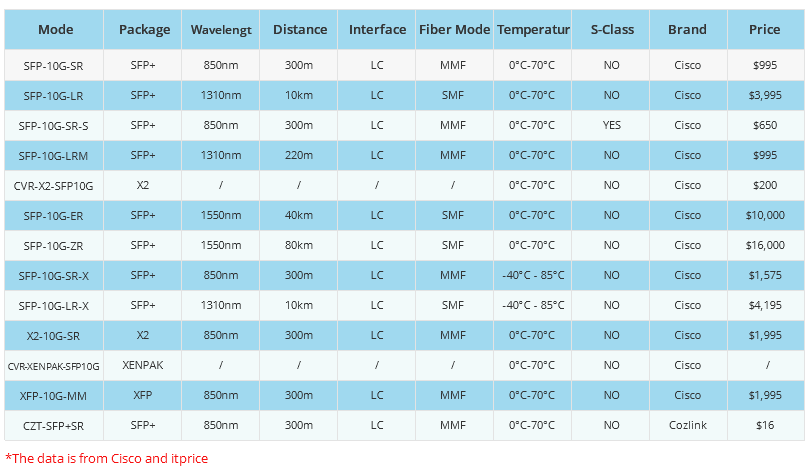
10BASE-SR ("short range") is a port type for multi-mode fiber and uses 850 nm lasers. Its Physical Coding Sublayer 64b/66b PCS is defined in IEEE 802.3 Clause 49 and its Physical Medium Dependent PMD in Clause 52. It delivers serialized data at a line rate of 10.3125 Gbit/s. The 10BASE-SR transmitter is implemented with a VCSEL which is low cost and low power. OM3 and OM4 optical cabling is sometimes described as laser optimized because they have been designed to work with VCSELs. 10GBASE-SR delivers the lowest cost, lowest power and smallest form factor optical modules.
What is the Difference Between 10BASE-SR and 10BASE-F?
The 10BASE-SR Module supports a link length of 26m on standard Fiber Distributed Data Interface (FDDI)-grade multimode fiber (MMF). Using 2000MHz*km MMF (OM3), up to 300m link lengths are possible. Using 4700MHz*km MMF (OM4), up to 400m link lengths are possible.
10BASE-F is a generic term for the family of 10 Mbit/s Ethernet standards using fiber optic cable. In 10BASE-F, the 10 represents its maximum throughput of 10 Mbit/s, BASE indicates its use of baseband transmission, and F indicates that it relies on medium of fiber-optic cable. In fact, there are at least three different kinds of 10BASE-F. All require two strands of 62.5/125 µm multimode fiber. One strand is used for data transmission and one strand is used for reception, making 10BASE-F a full-duplex technology.